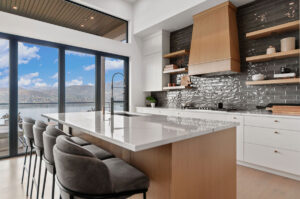
How to Choose the Right Kitchen Backsplash
A kitchen backsplash serves two purposes: it protects your walls and adds a decorative element to your kitchen. Before you commit to a tile, there are a few things to consider.
Will it work with the countertop you have selected? How much pattern or texture can your kitchen handle? And, most importantly, will the tile size work with the space?
Let’s take a closer look at how to choose a backsplash that gives you the look you’re after.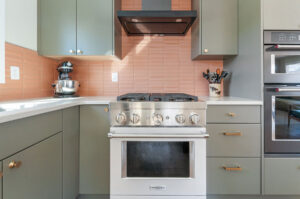
SELECT YOUR THEME
I often select the countertop first because it is a “fixed” element that you probably won’t replace for at least 10 years. It is also usually a significant investment.
When selecting a countertop, I first decide whether I want it to be the star of the kitchen or play a quieter supporting role.
Once the countertop is selected, I look for a backsplash tile that supports it. Do the two materials work together? One of my favourite ways to create a cohesive look is to find a repeating theme between the materials. This could be something organic, glossy, matte, textured or even a similar colour tone.
The goal isn’t necessarily for your countertop and backsplash to match. They simply need to feel like they belong together creating a cohesive kitchen backsplash design.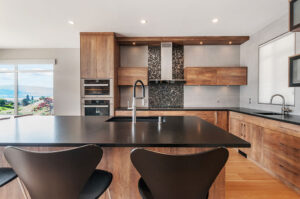
CHOOSE YOUR PATTERN OR TEXTURE
Once I’ve established the overall theme, I look at how much pattern and texture is already happening in the kitchen.
If your countertop has a strong pattern, you may want to choose a backsplash with less visual movement. Combining a very busy countertop with a highly patterned backsplash tile can make a kitchen feel visually overwhelming or disconnected.
If you have a large kitchen, you may have more room to introduce exciting elements in carefully chosen areas. In a smaller kitchen, less is often more. You can still add personality through lighting, hardware, artwork or other decorative details .
Remember, you don’t need every surface to make a statement.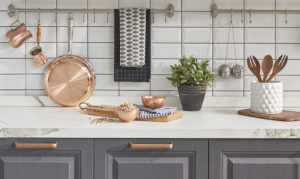
DOES THE MATH WORK?
One of the most important things to consider when selecting backsplash tile is the size of the area you need to cover.
The space between the countertop and upper cabinets is often around 18 inches, although this can vary depending on your kitchen. Because of this, the size and layout of your tile matter.
You don’t want to end up with lots of small, awkwardly cut pieces of tile. Not only can this affect the finished look, but it can also result in unnecessary tile waste.
This is also why I’m not a fan of using a 12″ x 24″ floor tile as a kitchen backsplash. In most kitchens, the scale can feel disproportionate to the space. Even if you’re thinking, “But I’ll install it vertically,” I’d reconsider.
I prefer 12″ x 24″ tiles for floors or shower walls, where their larger scale tends to work much better.
Don’t Forget the Grout
Finally, pay attention to your grout lines. A tighter grout joint is generally the more current look and allows the tile itself to take centre stage.
Of course, design is personal. If you’re intentionally creating a vintage or retro-inspired kitchen, a more noticeable grout line may be exactly what you’re looking for.
THE BOTTOM LINE
Choosing a kitchen backsplash isn’t just about finding a tile you love. You also need to consider how it works with your countertop, the amount of pattern and texture in the room, and whether the size of the tile makes sense for the space.
Get these details right, and your backsplash will feel intentional, balanced and connected to the rest of your kitchen.
And if you’d rather have a professional eye help you pull all of these elements together, that’s where an interior designer can make the process much easier. I’d be happy to help you create a kitchen that looks beautiful and works for the way you live.